The History of Psychoanalysis
Psychoanalysis is the most widespread, ramified, and one of the oldest psychotherapeutic approaches. Its history began in 1895, when the book by the Austrian neurologist and psychologist Sigmund Freud (1856–1939) “The Interpretation of Dreams” was published. Here he first set forth a psychological theory based on his practical observations, first as a neuropathologist, and then—as a psychotherapist proper. This book opened a new era in the development of both practical psychotherapy and fundamental psychology.
Freud’s theory quickly gained enormous popularity both in professional circles and among the general public. The psychotherapeutic movement he founded grew rapidly and spread to many countries in Europe and America. Subsequently, based on theoretical or methodological divergences from the “orthodox” Freudian approach (which is called “psychoanalysis” in the strict sense), numerous branches separated.
Structure of the Psyche
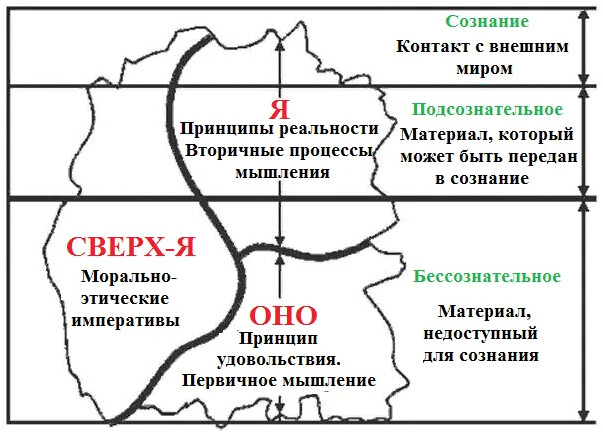
In the “orthodox” version, the theoretical basis of psychoanalysis consists of the two-dimensional structural model of the human psyche developed by Freud.
In the first dimension the psyche is divided into two main areas: consciousness and the unconscious.
Consciousness Freud interprets in accordance with the traditional definition dating back to Descartes as “the subject’s immediate experience.” This is precisely that part of internal experiences, thoughts, and feelings that are accessible to direct perception by the “inner eye.” In other words, consciousness is what a person directly and clearly knows about themselves.
The unconscious consists of those experiences, thoughts, and feelings that a person does not recognize, does not associate with themselves, but which nevertheless significantly influence their behavior and, what is especially important, their consciousness. The reasons why a particular mental content becomes unconscious (the process of translating conscious content into the unconscious—repression) are connected with the emotional “charge” (cathexis) of this content. That is, frightening or shameful contents are repressed.
The boundary between consciousness and the unconscious is blurred. This is a special zone of the psyche, which Freud calls the preconscious. The preconscious consists of mental contents that are usually not recognized by the subject but can be recognized without special difficulty by a simple effort of will, whereas the content of the unconscious proper can only be recognized with the help of special procedures.
In the second dimension the human psyche is divided into three elements:
-
The Id (other names: Id, depending on translation)—the most archaic part, which is present in the psyche from birth. It contains contents repressed from consciousness and two primary instincts (drives): Eros (sexual, creative) and Thanatos (death, destructive).
-
The Ego (other names: Ego)—a younger part, formed around the age of three. It brings impulses coming from the “Id” into conformity with the demands of society.
-
The Super-Ego (other names: Super-Ego)—the latest formation, formed in early adolescence. This is a system of internalized demands of society.
When these two schemes are superimposed (“consciousness—the unconscious” and “Id—Ego—Super-Ego”), it turns out that, according to Freud’s teaching, only parts of the Ego and Super-Ego are conscious.
Causes and Mechanisms of Neurosis Development
Freud’s ideas about the causes and mechanisms of neurosis development are directly relevant to psychotherapy.
Freud considers psychic traumas to be the causes of neurosis development, that is, situations of collision, conflict between instincts emanating from the Id and the demands of society (directly or through the mediation of the Super-Ego). Such conflicts arise constantly in a person’s life. To resolve them, the Ego uses a whole arsenal of defense mechanisms, the main of which is repression.
However, in some situations, defense mechanisms do not work properly, for example, because the drive coming from the Id turned out to be excessively intense or was excessively severely “punished” by society or the Super-Ego. As a consequence, the resulting conflict is repressed from consciousness without resolution. In this case, the traumatizing experience “seeks an outlet” in the form of neurosis, which in content is always connected with the repressed trauma.
For example, hysterical paralysis of the hands in a young pianist is a painful way to resolve the conflict between the inflated demands of parents or teachers for the girl’s art and her inability to meet these demands. Repressed experiences can manifest indirectly in dreams and so-called psychopathologies of everyday life, for example, all kinds of automatic slips of the tongue, errors in reading, etc.